Networked
European Software and Services Initiatives
A key role for European
Technology Platforms
In March 2003,
the European Spring Council encouraged the European
Commission to support the European Research and
Innovation Area by:
“
… creating European Technology Platforms
brining together technological know-how, industry,
regulators and financial institutions to develop a
strategic agenda for leading technologies”.
Four years
later, in March 2007, 31 European Technology Platforms
(ETPs) have been created, of which 8 operate in the area
of IST:
NESSI
Networked European Software and Services Initiative
ARTEMIS
Embedded Computing Systems
eMobility
Mobile and Wireless Communications
ENIAC
European Nanoelectronics Initiative Advisory Council
EPoSS
European Technology Platform on Smart Systems
Integration
EUROP
Robotics
ISI
Integral Satcom Initiative
NEM
Networked and Electronic Media
All platforms
aim, together, to deliver solutions that will enable
industrial innovations in different application areas,
from education and learning to manufacturing and health,
in public and private sectors alike. But in this common
goal, each platform has a clear role, the relative
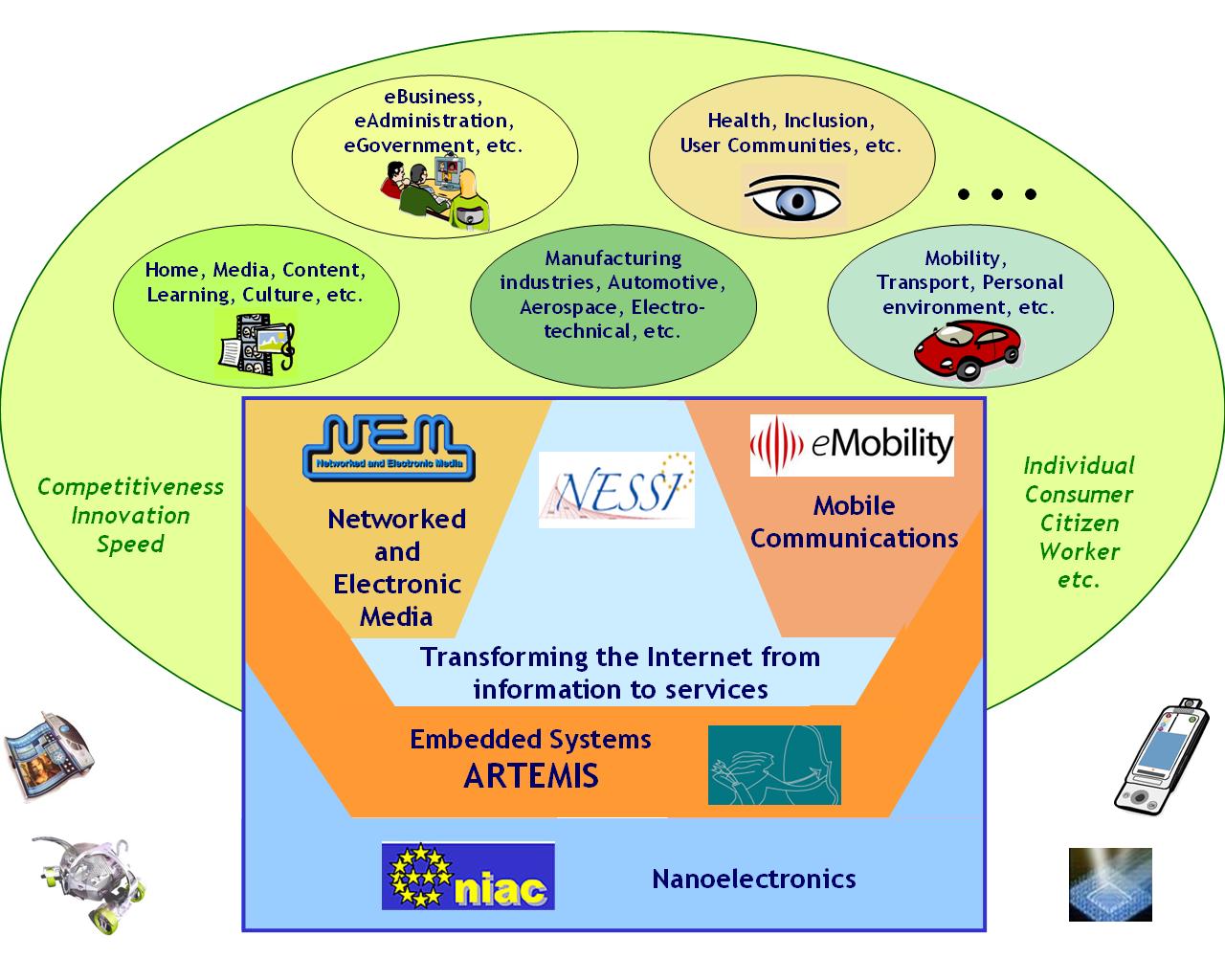
positioning of ARTEMIS, eMobility, Eniac, NEM and NESSI
is key to understand how together they shall all
contribute to the future economy and how, individually,
they have scoped the outputs they have to deliver to
ensure Europe’s future economical growth and a
clear driving role in the future of Internet.
In particular,
NESSI is the centrepiece of this puzzle, ensuring that a
services infrastructure comes to live without which any
of the new devices, interfaces and Internet
infrastructures can deliver on the overall promise.
European
Technology Platforms embody the strategic mechanisms
through which Europe will seize new opportunities and
exploit its global capability, not only to the benefit of
the ICT industry, but also to that of all economic
sectors, and in the end, to the benefit of all citizens.
Figure 1. A key
role for European Technology Platforms
The evolving role of
Technology Platforms
The 3rd
status report on ETPs clearly analyses the opportunity
for ETPs to play an important role beyond the definition
and implementation of their SRA. An Independent Expert
Group appointed by the European Council in October 2005
issued the so-called Aho Report 6. This report identified
ETPs as key organisational innovation in the creation and
exploitation of innovation-friendly markets”.
In a recent
Commission Communication 6 outlining a broad based
innovation strategy for the EU, the role of European
Technology Platforms to contribute to a new lead market
initiative has been outlined: "The
Commission will test in 2007 a strategy to facilitate
the emergence of innovation friendly lead-markets. In
this context, it will conduct, after a public
consultation including in particular the Technology
Platforms and the Europe INNOVA innovation panels, a
detailed analysis of potential barriers to the take-up
of new technologies in a limited number of areas. In
parallel, using this experience, the Commission will
prepare a comprehensive lead markets strategy. "
The role of
European Technology Platforms has thus expanded: from
defining strategic priorities for research and
development at European level to contributing to set the
framework under which these investments will provide
higher returns for the European economy and society. This
role will likely be strengthened in the near future.
The context of NESSI
Launched in
September 2005, NESSI focuses on the paradigm shift that
is driving the European economy towards a service
oriented approach. This shift has an enormous impact on
the creation and distribution of software, while at the
same time opening opportunities for unprecedented levels
of collaboration between companies using such an
approach.
NESSI’s
industrial goal is to deliver open, standard,
interoperable, safe and secure services environments in
which all ICT companies, small and large, will be able to
provide new solutions by relying on a tested
infrastructure and focusing on their key capacities.
After more
than 2 years of existence, NESSI has achieved results
– and has at the same time fully validated and
embraced the European Technology Platform approach. Since
September 2005, NESSI has:
13 partners
united in September 2005 around a common vision for
software and services 6. Enlarged to 23 partners on July
2007.
Through its
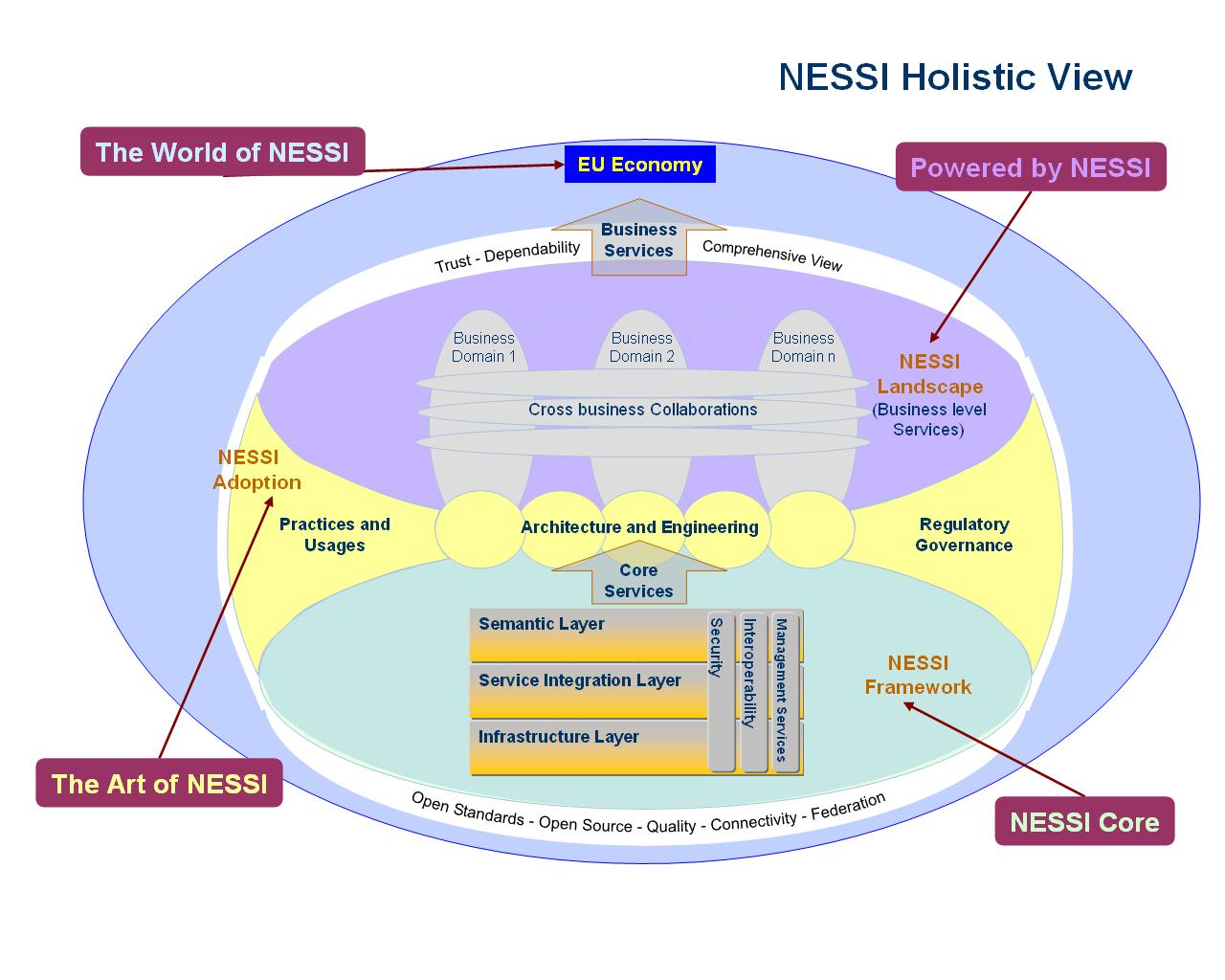
successive volumes, NESSI has defined a holistic model
(figure 2) that encompasses different layers:
The
Framework - core technologies
The
Landscape - the business environment in which services
will be delivered
The
Adoption – the regulatory, training and
standardisation environments that have to be addressed
to ensure that services will be able to operate across
geographical borders, application areas, domains.
Figure 2 –
NESSI’s Holistic model
Today NESSI
includes 300 members and 23 partners. Collectively, this
community represents 1.7 Million strong
workforce and 490 B€ annual
revenues. It also represents leading players including
industries, SMEs, Academia and users sharing
the vision of a common long term strategy on software
and services to contribute to Europe’s
competitiveness, job sustainability and quality of life.
Its partners are Alcatel, Atos Origin, BT, Engineering,
HP, Fraunhofer Institute, IBM, Inria / OW2, Lero, Logica
CMG, MoMa, Nokia, SAP, Siemens, Software AG, Sun, Telecom
Italia, Rodan Systems, Telefonica, Thales, TIE,
Universidad Politecnica de Madrid.
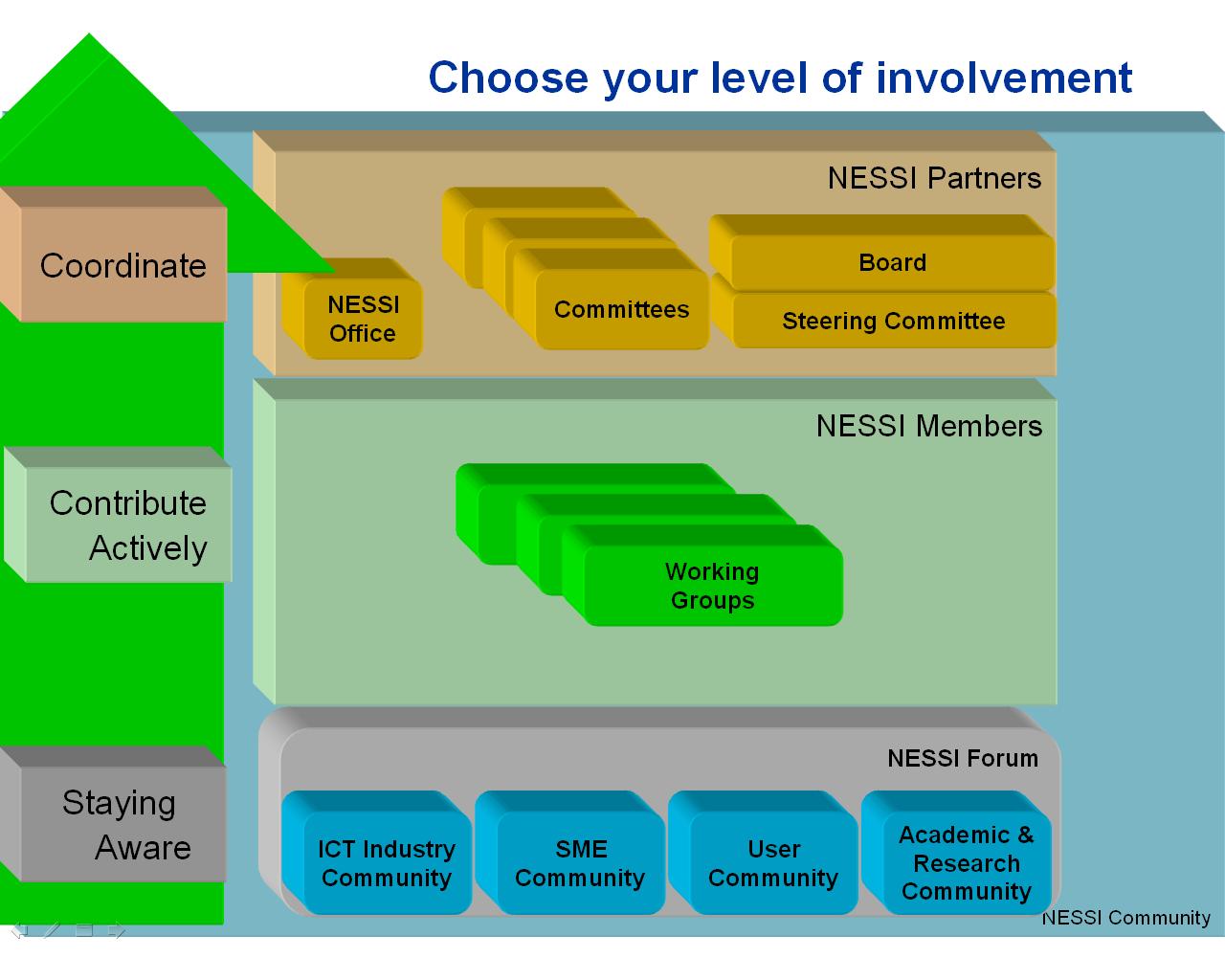
To ensure the
right balance between openness and coordination (Figure
3) NESSI’s model foresees different levels of
participation and is totally open to all stakeholders
through a simple on-line membership process. This has
enabled the Community to grow across different
directions, with the percentage spread of membership
detailed in the following table:
|
Membership
|
SMEs
|
ICT Community
|
Users
|
Academics
|
|
%
|
22
|
22
|
4
|
51
|
Figure 3–
NESSI’s Governance – choosing the level of
involvement from staying aware to coordination
To achieve the
right level between openness and coordination leading to
achievements, NESSI partners operate through internal
Committees, namely the Board, Steering, SRA, Strategy
& Communication and Standardisation Committees. These
Committees are supported by the NESSI Office.
The
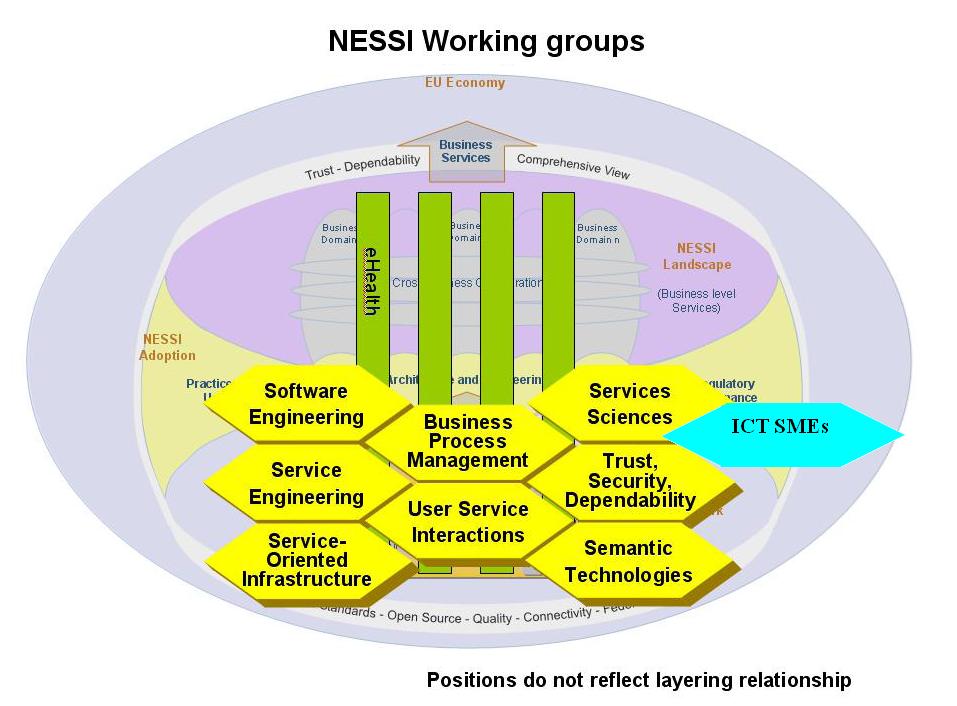
participative model relies on the NESSI Working Groups
open to all NESSI members, of which 12 are currently in
operation and more user-oriented ones are foreseen in the
near future. How those WGs are located in the NESSI is
depicted in Figure 4. These working groups are central
to NESSI, uniting around specific topics within the SRA
and delivering to the SRA the refined needs and
requirements that need to be addressed.
The list of
horizontal working groups is the following
Service-Oriented Infrastructure
Business
Process Management
Trust,
Security and Dependability
Services
Sciences
The set of
vertical working groups is:
We also have
the ICT SMEs Working group and Open Source working group.
Figure 4 –
NESSI’s Working Groups
In parallel,
these working groups are THE place where NESSI partners
and members of all types unite to create research areas
and analyse existing results for future integration.
During 2007 and 2008, new working groups will emerge,
most of which will operate in the NESSI Landscape
alongside the first eHealth working group. Areas
currently under investigation include learning skills,
human resources, manufacturing, transport.
Defined
the main output which NESSI expects to deliver, i.e.
NEXOF, the open service model, reference architecture,
and implementation.
NEXOF, the
NESSI Open Framework, is an integrated, consistent and
coherent set of technologies and associated methods and
tools intended to:
Provide
European Industry and the Public Sector with efficient
services and software infrastructures to improve
flexibility, interoperability and quality;
Master
complex software systems and their provision as service
oriented utilities;
Establish
the technological basis, the strategies and deployment
policies to speed up the dynamics of the services
eco-system;
Develop
novel technologies, strategies and deployment policies
that foster openness, through the increased adoption of
open standards and open source software as well as the
provision of open services;
Fostering
safety, security and the well-being of citizens by
means of new societal applications, enhanced efficiency
of industry and administrations, and competitive jobs.
Thus, the
overall ambition of NEXOF is to deliver a coherent and
consistent open service framework,
ranging from the infrastructure up to the interfaces with
the end users, leveraging research in the area of
service-based systems to consolidate and trigger
innovation in service-oriented economies for the benefit
of the whole European Economy.
The NESSI Open
Framework will be composed of:
A
Reference Model, to describe the main concepts from
the point of view of both technology and business;
A
Reference Architecture, to formalise the model into
open specifications allowing the exact implementation
of the service environment in different domains and
technologies;
A
Reference Implementation, to make NEXOF happen serving
as the guide for further NEXOF instantiations by
different organisations for different domains adopting
different technological approaches. This is a complex
of methods, tools and technologies released as open
source allowing derivative works;
A
Compliance Test Suite, to validate each NEXOF instance
and the related provided services, not only to be fully
operational, but also to be compliant with the
Reference Architecture so that to assure the maximum
interoperability.
NESSI – facing the
future
While the
first two years of NESSI were intense and successful in
uniting a large industrial and research community, its
future challenges are focused on:
Enlarging
its user community
Building up
the ICT SME participation to ensure that NEXOF is
defined with clear SME support in terms of content,
flexibility and accessibility
Structuring
the research in collaboration with academia,
international and national initiatives and programmes
Integrating
existing and new research results to generate
successful iterations of NEXOF
Furthering
the standardisation links it has already established
with OMG, IEEE, ETSI to ensure that the
interoperability and security needs are addressed by
world-wide standards. NESSI aims at being a key player
in this arena and has established a NESSI
Standardisation committee to this effect.
Sustaining
the momentum of all its communities and ensuring
participation of existing members
Maintaining
the dynamics of the awareness activity, ensuring that
NESSI is know and increasing its adoption rate
Through all
these challenges, NESSI’s evolution is directly
aligned to the European political and research
strategies, defined in the Commission’s
Communication 6, the ERANET construction and the ETPs
roles recognised as key in lead markets and in research
coordination.
NESSI Key
challenges: coordination with national initiatives
These specific
roles for NESSI are further detailed in the following
pages, through Key Challenges identified as important to
the general goals of an ETP or specific to NESSI.
“ETPs
provide a framework for the development of collaboration
strategies at regional and national level».
Objectives under Challenges 1, 2, 3, 5, 6 and 7 as well
as FET call for the coordination of national or regional
research programmes or initiatives.
Several
national initiatives on the S&S area have been
created in the last months; some of them were born in
parallel and directly linked to NESSI (i.e. Spanish
initiative INES) and some others were created after. The
final objective of NESSI is to establish links with those
national initiatives or technology platforms, focusing
this collaboration in the following aspects:
Creation
of Awareness. This consists of informing the general
and specialist audience about the existence of NESSI.
Understanding.
This task consists of explaining a more specialist
audience and project stakeholders, which benefits the
project provides and how the results can be
exploited.
Action.
This stage consists of promoting the active
participation in NESSI of the audiences. It also
comprises the participation of NESSI in external
initiatives and activities, related to the audiences
targeted by this task.
In order to
foster coordination between NESSI and national or
regional research programmes in the field of Software and
Services, a dedicated set of activities have been
created. The objective of those is mainly to promote
NESSI adoption at national and regional level and to
achieve the creation of joint activities.
Conclusions
In summary the
main future actions of NESSI will be focus in three main
objectives that are related to the challenges that the
European Technology Platform is facing.
Most of the
efforts will be devoted to the main output of NESSI, the
Open Framework, and the integration of research results
in future iterations. Development, implementation,
integration with other results and dissemination of it
will be the tasks in relation with NESSI Open Framework.
It also aims
to fully settle up and enable the collaboration with the
different national and regional initiatives on the
S&S area, in order to ensure a bigger adoption and
cooperation with those initiatives and its working
groups. Moreover coordination of those national and
regional activities is expected.
References
The 3rd
ETP Status Report – March 2003 – available
from Cordis at
ftp://ftp.cordis.europa.eu/pub/technology-platforms/docs/etp3rdreport_en.pdf
Communication
from the Commission to the Council, the European
Parliament, the European Economic and Social Committee
and the Committee of the Regions - Putting knowledge
into practice: A broad-based innovation strategy for
the EU Com 2006 502 / Issued on 13/9/2006
“Vision
Document 2020 – Software and Services”
– long term vision of the NESSI Platform, May
2005 – available from www.nessi-europe.eu
NESSI’s
SRA – Volume 1 and 3 – available from www.nessi-europe.eu.